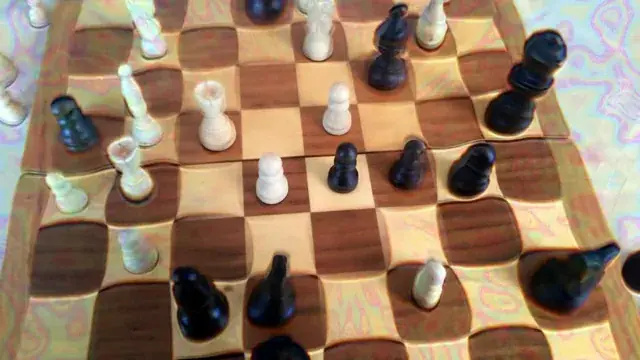
Drifting
Drifting is the experience of the texture, shape, and general structure of objects and scenery appearing progressively warped, melted, and morphed across themselves. It is most commonly induced under the influence of moderate dosages of psychedelic compounds, such as LSD, psilocybin, and mescaline.
Drifting is the experience of the texture, shape, and general structure of objects and scenery appearing progressively warped, melted, and morphed across themselves.123 These alterations gradually intensify as a person stares, but are temporary and will reset to normality the moment a person refocuses their gaze.
Drifting is often accompanied by other coinciding effects, such as texture liquidation and tracers.34 It is most commonly induced under the influence of moderate dosages of psychedelic compounds, such as LSD, psilocybin, and mescaline. However, it can also occur to a lesser extent under the influence of MDMA, cannabis, and certain dissociatives, such as DXM or 3-MeO-PCP.
Sub-types
The various subtypes of this visual effect are defined by the continuously changing direction, speed, and rhythm of the distortion. This results in a small variety of different manifestations which are defined and listed below:
Morphing
Morphing can be described as a style of visual drifting that is completely disorganised and spontaneous in both its rhythm and direction. It results in objects and scenery appearing to progressively morph and warp in their size, shape, and configuration.
Breathing
Breathing can be described as a style of visual drifting that results in objects and scenery appearing to steadily contract inwards and expand outwards in a consistent rhythm, similar to the lungs of a living organism.Melting
Melting can be described as a style of visual drifting that results in the texture of objects and scenery appearing to completely or partially melt. It begins at lower intensities as a gradual distortion of an object's texture which causes them to subtly droop, wobble, and lose their structural integrity. This gradually increases until it becomes impossible to ignore as the lines, textures, and colour between solid objects melt into one another in an extremely fluid style.Flowing
Flowing can be described as a style of visual drifting that seems to occur almost exclusively on textures (particularly if they are highly detailed, complex, or rough in appearance). It results in the textures appearing to flow like a river in a seamless, looped animation. It is particularly common on wood grain or the fur of animals.Levelling System
Regardless of sub-type, this effect is capable of manifesting itself across the 4 different levels of intensity described below: