
Loading page
Loading page
Loading category route
This article breaks down the subjective effects of the psychedelic experience into simple and easy to understand descriptions with accompanying image replications. This is done without resorting to metaphors, analogies, or personal trip reports.
These descriptions are not specific to any particular substance but are applicable to the effects which commonly occur in various forms under the influence of almost any psychedelic compound. This includes, but is not limited to, both classical and research chemical psychedelics, such as:
LSD, Psilocybin mushrooms, DMT, Ayahuasca, Mescaline, 5-MeO-MiPT, 2C-B, LSA, AL-LAD, ALD-52, 1P-LSD, 2C-B-Fly, 2C-C, 2C-D, 2C-E, 2C-P, 4-AcO-DMT, 4-HO-MET, 4-HO-MiPT, 5-MeO-DMT, DPT, and DOC.
The article begins with a description of the simpler effects and works its way up towards more complex experiences as it progresses. Individual effects are also summarized with a link to their full article.
Visual Amplifications are defined as any subjective effect that increases, enhances, or intensifies a facet of a person's sense of sight.
Full article: Visual acuity enhancement
Visual acuity enhancement is a heightening of the clearness and clarity of vision. This results in the visual details of the external environment becoming sharpened, to the point where the edges of objects are perceived as extremely focused, clear, and defined. The experience of acuity enhancement can be likened to bringing a camera or projector lens that was slightly blurry into focus.
Visual acuity enhancement is often accompanied by other coinciding effects, such as colour enhancement and increased pareidolia. It is most commonly induced under the influence of mild dosages of psychedelic compounds, such as LSD, psilocybin, and mescaline.
Full article: Colour enhancement
Colour enhancement is a perceived intensification of the brightness and vividness of colours in the external environment. During this experience, reds may seem “redder”, greens may seem “greener", and all colours will likely appear much more distinct, complex, and visually intense than they comparatively would during everyday sober living. At higher levels, this effect can sometimes result in seeing colours that are perceived as surreal or seemingly impossible.
Colour enhancement is often accompanied by other coinciding effects such as visual acuity enhancement and increased pareidolia. It is most commonly induced under the influence of mild dosages of psychedelic compounds, such as LSD, psilocybin, and mescaline. However, it can also occur to a lesser extent under the influence of certain stimulants and dissociatives such as MDMA, ketamine, or 3-MeO-PCP.
Full article: Increased pareidolia
Increased pareidolia is an increase in a person's ability and tendency to recognise patterns (usually faces) within vague stimuli.
This innate ability that human beings possess in everyday life is referred to by scientific literature as pareidolia and is a well-documented phenomenon. Common examples of this include spotting faces in everyday objects, such as the front of a car, or seeing different objects in clouds.
During this experience, pareidolia can be significantly more pronounced than it would be during a sober state. For example, remarkably detailed images may appear embedded in scenery, everyday objects may look like faces, and clouds may appear as fantastical objects, all without any visual alterations taking place.
Increased pareidolia is often accompanied by other coinciding effects, such as visual acuity enhancement and colour enhancement. It is most commonly induced under the influence of mild dosages of psychedelic compounds, such as LSD, psilocybin, and mescaline.

This replication serves as an image example for pattern recognition, specifically in the form of faces within forest scenery.
Artist: Bev Doolittle
Visual Distortions are any subjective effect which alters and changes the perception or appearance of pre-existing visual data without adding any entirely new content.
Full article: After images
After images are visual perceptions that continue to appear in one's vision after exposure to the original image has ceased.
During this experience, moving objects can produce a trail of overlayed, still images behind their path of motion. This creates a series of overlayed images of a moving object across one's visual field that progressively fade away. For example, common manifestations of this effect include seeing faded images left in the path of moving objects or being able to see a residual image of the external environment for several seconds after one closes their eyes.
After images are often accompanied by other coinciding effects, such as tracers and drifting. It is most commonly induced under the influence of moderate dosages of psychedelic compounds, such as LSD, psilocybin, and mescaline.

An image example of after images as seen following behind a moving hand.
Artist: Chelsea Morgan
Full article: Colour shifting
Colour shifting is when objects within the environment fluidly shift and change their colour through a continuously repeating cycle. For example, moss on a rock could visibly shift from green, to red, to blue, to any other colour, and then back to green again in the style of a smooth and seamless animated loop. It is particularly strong and likely to occur if the objects original colour was bright or out of place.
Colour shifting is often accompanied by other coinciding effects, such as colour enhancement and colour replacement. It is most commonly induced under the influence of moderate dosages of psychedelic compounds, such as LSD, psilocybin, and mescaline.
Full article: Depth perception distortions
Depth perception distortions are alterations in how a person perceives the distance of various objects within their visual field. During this state, the various layers of scenery can become exaggerated, skewed, or completely rearranged.
An example of this could be the swapping of layers in a given environment, in which objects in the background begin to appear as if they are in the foreground and objects in the foreground appear as if they are in the background. In other instances, the same distortion is applied to the entire visual field, such as everything appearing small and distant or large and near. Another example is the complete loss of depth perception. This occurs when the different sections of a scene appear to unify into a flat 2-dimensional image regardless of their actual distance from each other and the observer.
Depth perception distortions are often accompanied by other coinciding effects, such as perspective distortions and drifting. They are most commonly induced under the influence of moderate dosages of psychedelic compounds, such as LSD, psilocybin, and mescaline.
Full article: Drifting
Drifting is the experience of the texture, shape, and general structure of objects and scenery appearing progressively warped, melted, and morphed across themselves. These alterations gradually increase in intensity as a person stares, but are temporary and will reset to their normal appearance the moment a person double takes.
At lower levels, drifting will manifest as a subtle bending or morphing of the textures and objects within a person's external environment. At higher levels, drifting becomes powerful enough to drastically alter and transform the shape of specific objects within a person’s external environment.
The particular style of this visual effect depends on the continuously changing direction, speed, and rhythm of the distortion. This results in a small variety of different manifestations which includes morphing, breathing, melting, and flowing.
Drifting is often accompanied by other coinciding effects such as texture liquidation and tracers. It is most commonly induced under the influence of moderate dosages of psychedelic compounds, such as LSD, psilocybin, and mescaline.
Full article: Recursion
Recursion is a visual distortion that alters the appearance of one's external environment by repeating specific sections of itself across itself in a self-similar fashion. It results in the appearance of fractal-like patterns that often zoom into or away from the original image. This effect typically occurs spontaneously and rarely sustains itself for more than several seconds.
Recursion is often accompanied by other coinciding effects, such as geometry and symmetrical texture repetition. It is most commonly induced under the influence of moderate dosages of psychedelic compounds, such as LSD, psilocybin, and mescaline.

This animation serves as an image example of a psychedelic recursion, as seen within a cat's face.
Artist: Anonymous
Full article: Symmetrical texture repetition
Symmetrical texture repetition is the perception of textures becoming mirrored repeatedly over their own surface in an intricate and symmetrical fashion that is consistent across itself. This maintains the same level of detail no matter how closely one attempts to look at the distortion and tends to remain most prominent within one's peripheral vision. It usually manifests itself in rough textures, such as grass, carpets, tree bark, and asphalt.
Symmetrical texture repetition is often accompanied by other coinciding effects, such as increased pareidolia and transformations. This can result in the appearance of an array of abstract forms and imagery embedded within the symmetry. It is most commonly induced under the influence of mild dosages of psychedelic compounds, such as LSD, psilocybin, and mescaline.
This replication serves as an image example for symmetrical texture repetition, as seen within grass. Artist: Grass
Full article: Tracers
Tracers are the experience of visual trails of varying lengths and opacity being left behind moving objects in a manner that is similar to those found in long exposure photography. They will usually manifest as exactly the same colour of the moving object producing it or can sometimes be a randomly selected colour of their own. A relatively consistent way to reproduce this visual effect is to simply move one's hand in front of their face or throw an object under the influence of a moderate dose of psychedelics.
At lower levels, tracers typically manifest as partially transparent trails that disappear quickly and drag closely behind moving objects. At higher levels, tracers become mostly solid in appearance and almost completely opaque with increasingly distinct edges. They also become slower to fade from a person’s vision and can remain for up to several seconds.
Tracers are often accompanied by other coinciding effects, such as drifting and after images. They are most commonly induced under the influence of mild dosages of psychedelic compounds, such as LSD, psilocybin, and mescaline.

This replication serves as an image example for tracers, as seen within a pair of tumbling dice.
Artist: Rosendahl
Full article: Texture liquidation

An image example of texture liquidation as seen on a sunflower.
Texture liquidation is the experience of the texture, shape, and general structure of objects and scenery appearing progressively simplified, smudged and stylized in such a way that one's external environment begins to take on the general appearance of a painting or cartoon.
Texture liquidation is often accompanied by other coinciding effects, such as visual acuity enhancement and drifting. It is most commonly induced under the influence of moderate dosages of psychedelic compounds, such as LSD, psilocybin, and mescaline.
Geometric Patterns are defined as any subjective effect that introduces complex arrays of shapes, colours, symbols, patterns, geometry, form constants, and fractals to one's field of vision.
Full article: Environmental patterning
Environmental patterning is the experience of certain textures or objects, such as carpets, clouds, and dense vegetation, drifting into increasingly complex geometric patterns that are clearly comprised of the original material they are manifesting from. These structures can be symmetrical in nature, but often include form constants, fractals, and disorganised geometric patterns.
Environmental patterning is often accompanied by other coinciding effects, such as symmetrical texture repetition, geometry, and drifting. It is most commonly induced under the influence of moderate dosages of psychedelic compounds, such as LSD, psilocybin, and mescaline.
Full article: Geometry

This image serves as an example of a single frame of typical level 4 psychedelic geometry.
Artist: Sam Perkins
Geometry is the experience of a person's field of vision becoming partially or completely encompassed by fast-moving, colourful, and extremely complex geometric patterns, form constants, shapes, fractals, and colours.
Geometry is rarely motionless and is generally extremely fast-moving and self-changing in its shape and style. During this process, the geometry naturally drifts across the visual field while fluidly transitioning through many distinct states and forms.
At lower levels, geometry will display itself as a translucent sheen that is overlaid onto the person's environment and closed eye vision. At higher levels, the geometry will become increasingly complex and intense until it has begun to block out and replace the external world. The visual perception of a person's environment begins to be replaced by geometry, with objects and scenery either transforming into complex geometric structures or simply being blocked out and covered by them.
Geometry is often accompanied by other coinciding effects such as internal hallucinations, environmental patterning, and drifting. It is most commonly induced under the influence of moderate dosages of psychedelic compounds such as LSD, psilocybin, and mescaline.
Hallucinatory States are any subjective effect which changes the perception or appearance of pre-existing visual data by adding entirely new content in a manner which is similar to that of dreams.
Full article: Magnification
Magnification is the experience of distant details within one's visual field appearing magnified and closer than they actually are. This can give the perception that one is seeing objects from greater distances than is usually possible within everyday life.
At its lower levels, this can allow people to see nearby objects (such as within reaching distance) as much closer than they really are, resulting in the perception that their visual capabilities have been somewhat enhanced. At its higher levels, this can induce the perception of seeing distant objects as if they were right in front of the user despite their distance. These distances can range from several feet to hundreds of meters. Alternatively, it can also result in states in which a person's vision will zoom into the minute details of a small object, allowing them to see it from a perspective similar to that of a microscope. Since this is almost certainly a physiological impossibility, it suggests that higher level magnification may actually be a seamless hallucinatory state in which the details of distant visual input are predictively simulated in a realistic and convincing manner.
Magnification is often accompanied by other coinciding effects such as visual acuity enhancement and increased pareidolia. It is a rare effect that is most commonly induced under the influence of moderate dosages of psychedelic compounds, such as LSD, psilocybin, and mescaline.
Full article: Autonomous entity
An autonomous entity is the experience of perceived contact with beings that appear to be sentient and autonomous in their behaviour. They will frequently act as the inhabitants of a perceived independent reality. Although many entities seem largely unaware of a person’s presence, they are often precognizant of a person's appearance into their realm and usually choose to interact with them in various ways. The behaviour of a typical entity can vary wildly and seems to depend heavily on one's current emotional state. For example, while many entities will act as loving beings, teachers, or healers in certain contexts, they are equally capable of acting as indifferent, uncaring or even malicious tormentors.
Entities under the influence of psychedelics usually appear as if they are comprised of condensed psychedelic geometry. They can take any form, but certain archetypes are present and commonly include:
Humans, shadow people, bodiless super intelligent humanoids, aliens, elves, animals, giant spheres, insectoids, beings of light, anthropomorphic beings, plants, conscious inanimate objects, fictional characters, cartoons, robotic machines, gods, demigods, goddesses, bio-mechanical intelligences, hooded figures, demons, indescribable monstrosities, spirits, angels, shamans, ghosts, souls, ancestors, fantastical or mythological beasts, glitch creatures and more.
This experience is often accompanied by other coinciding effects, such as geometry, internal hallucinations, and delusions. It is most commonly induced under the influence of heavy dosages of hallucinogenic compounds, such as psychedelics, dissociatives, and deliriants.
Full article: Transformations
Transformations are the experience of a perceived visual metamorphosis that specific parts of one's external environment undergo as they shapeshift into other objects. For example, people who experience this effect will often report seeing parts of their environment shifting into completely different things. These transformations have a huge variety of potential artistic styles and differing levels of detail, realism, and animation.
These hallucinations are progressive in nature. They form from patterns or objects and their appearance fluidly drifts into an entirely new form over several seconds. This is caused and enhanced by a separate visual effect known as increased pareidolia, which can cause vague stimuli and objects to transform into incredibly detailed versions of what they were already perceived as.
At lower levels, the process of transformation can require some minimal amount of focus and concentration to sustain. Losing concentration for an instant can cause the image to fade away or shift into another image. Holding the eyes still will usually increase the intensity of the progressive transformation. However, this becomes completely unnecessary at higher levels.
Transformations are often accompanied by other coinciding effects, such as drifting, increased pareidolia and external hallucinations. They are most commonly induced under the influence of moderate dosages of psychedelic compounds, such as LSD, psilocybin, and mescaline.
Full article: Internal hallucination
Cognitive Amplifications are defined as any subjective effect that increases, enhances, or intensifies a facet of a person's sense of cognition.
Full article: Analysis enhancement
Analysis enhancement is a perceived improvement of a person's overall ability to logically process information or creatively analyze concepts, ideas, and scenarios. This effect can lead to a deep state of contemplation that often results in an abundance of new and insightful ideas. It can give the person a perceived ability to better analyze concepts and problems, allowing them to reach new conclusions, perspectives, and solutions that would have been otherwise difficult to conceive.
Although this effect will often result in deep states of introspection, in other cases it can produce states that are not introspective but instead result in a deep analysis of the exterior world, both taken as a whole and as the things comprising it. This can result in a perceived abundance of insightful ideas and conclusions with powerful themes pertaining to what is often described as "the bigger picture". These ideas generally involve (but are not limited to) insights into philosophy, science, spirituality, society, culture, universal progress, humanity, loved ones, the finite nature of our lives, history, the present moment, and future possibilities.
Analysis enhancement is often accompanied by other coinciding effects, such as stimulation, personal bias suppression, conceptual thinking, and thought connectivity. Although it is most commonly induced under the influence of moderate dosages of stimulant and nootropic compounds, it also occurs in a more powerful although less consistent form under the influence of psychedelics, such as certain LSD, psilocybin, and mescaline.
Full article: Increased suggestibility
Increased suggestibility is a greater tendency to accept and act on the suggestions of others. A common example of increased suggestibility in action would be a trip sitter deliberately making a person believe a false statement without question simply by telling it to them as true, even if the statement would usually be easily recognizable as impossible or absurd. If this is successfully accomplished, it can potentially result in the experience of relevant accompanying hallucinations and delusions which further solidify the belief which has been suggested to them.
Suggestibility enhancement most commonly occurs under the influence of heavy dosages of hallucinogenic compounds, such as psychedelics, dissociatives, deliriants, and cannabinoids. It is most commonly induced under the influence of hallucinogens such as include LSD, mescaline, psilocybin, cannabis, ketamine, and nitrous oxide.
Full article: Increased music appreciation
Increased music appreciation is a general sense of an increased enjoyment of music. When music is listened to during this state, not only does it subjectively sound better, but the perceived music and lyrical content may have a profound impact on the listener.
This experience can give one a sense of hyper-awareness of every sound, lyric, melody, and complex layer of noise within a song in addition to an enhanced ability to individually comprehend their significance and interplay. The perceived emotional intent of the musician and the meaning of the music may also be felt in a greater level of clarity than it would be during everyday sober living. This effect can result in the belief, legitimate or delusional, that one has connected with the “true meaning” or “spirit” behind an artist’s song. During particularly enjoyable songs, this effect can result in feelings of overwhelming harmony and a general sense of appreciation that can leave the person with a deep sense of connection towards the artist they are listening to.
Increased music appreciation is commonly mistaken as a purely auditory effect, but is more likely the result of several coinciding components, such as novelty enhancement, personal meaning enhancement, emotion enhancement, and auditory enhancement. It is most commonly induced under the influence of moderate dosages of hallucinogenic compounds, such as psychedelics, dissociatives, and cannabinoids.
Full article: Novelty enhancement
Novelty enhancement is a feeling of increased fascination, awe, and appreciation attributed to specific parts or the entirety of one's external environment. This can result in an often overwhelming impression that everyday concepts such as nature, existence, common events, and even household objects are now considerably more profound, interesting, and important.
The experience of this effect commonly forces those who undergo it to acknowledge, consider, and appreciate the things around them in a level of detail and intensity which remains largely unparalleled throughout every day sobriety. It is often generally described using phrases such as "a sense of wonder" or "seeing the world as new".
Novelty enhancement is often accompanied by other coinciding effects such as personal bias suppression, motivation enhancement, and spirituality enhancement in a manner which further intensifies the experience. It is most commonly induced under the influence of moderate dosages of psychedelic compounds, such as LSD, psilocybin, and mescaline.
Full article: Thought connectivity
Thought connectivity is an alteration of a person's thought stream which is characterized by a distinct increase in wandering thoughts which connect into each other through a fluid association of ideas. During this state, thoughts may be subjectively experienced as a continuous stream of vaguely related ideas which tenuously connect into each other by incorporating a concept that was contained within the previous thought. When experienced, it is often likened to a complex game of word association.
During this state, it is often difficult for the person to consciously guide the direction of their thoughts in a manner that leads into a state of increased distractibility. This will usually also result in one's train of thought contemplating an extremely broad variety of subjects, which can range from important, trivial, insightful, and nonsensical topics.
Thought connectivity is often accompanied by other coinciding effects such as thought acceleration and creativity enhancement. It is most commonly induced under the influence of moderate dosages of psychedelic compounds, such as LSD, psilocybin, and mescaline.
Full article: Emotion intensification
Emotion intensification is an increase in a person's current emotional state beyond normal levels of intensity.
Unlike many other subjective effects, such as euphoria or anxiety, this effect does not actively induce specific emotions regardless of a person's current state of mind and mental stability. Instead, it works by passively amplifying and enhancing the genuine emotions that a person is already feeling prior to ingesting the drug or prior to the onset of this effect. This causes emotion intensification to be equally capable of manifesting in both a positive and negative direction. This effect highlights the importance of set and setting when using psychedelics in a therapeutic context, especially if the goal is to produce a catharsis.
For example, an individual who is currently feeling somewhat anxious or emotionally unstable may become overwhelmed with intensified negative emotions, paranoia, and confusion. In contrast, an individual who is generally feeling positive and emotionally stable is more likely to find themselves overwhelmed with states of emotional euphoria, happiness, and feelings of general contentment. The intensity of emotional states felt under this effect can shape the tone of a trip and predispose the user to other effects, such as mania or unity in positive states and thought loops or feelings of impending doom in negative states.
Emotion intensifcation is most commonly induced under the influence of moderate dosages of psychedelic compounds, such as LSD, psilocybin, and mescaline. However, it can also occur under the influence of cannabinoids, GABAergic depressants, and stimulants.
Full article: Increased sense of humor
Increased sense of humor is as a general enhancement of the likelihood and degree to which a person finds stimuli to be humorous and amusing. During this state, a person's sensitivity to finding things funny is noticeably amplified, often to the point that they will begin uncontrollably laughing at trivial things without any intelligible reason or apparent cause.
Increased sense of humor is often accompanied by other coinciding effects such as emotion enhancement and novelty enhancement. It is most commonly induced under the influence of moderate dosages of certain hallucinogenic compounds, such as psychedelics, and cannabinoids.
Full article: Personal meaning enhancement
Personal meaning enhancement is the experience of a considerably increased sense of personal significance becoming attributed to innocuous situations, and coincidences. For example, one may feel that the lyrics of a song or events in a film directly relate to their life in a meaningful and distinct manner that is not usually felt during everyday sobriety. This feeling can continue to occur even when it is rationally understood that the external stimuli do not genuinely relate to the person experiencing it in such a direct manner.
At its highest level, this effect will often synergize with delusions in a manner which can result in one genuinely believing that innocuous events are directly related to them. For example, one may begin to believe that the plot of a film is about their life or that a song was written for them. This phenomenon is well established within psychology and is commonly known as a "delusion of reference".
Personal meaning enhancement is most commonly induced under the influence of moderate dosages of hallucinogenic compounds, such as psychedelics, dissociatives, cannabinoids, and deliriants.
Full article: Anxiety
Anxiety is medically recognized as the experience of negative feelings of apprehension, worry, and general unease. These feelings can range from subtle and ignorable to intense and overwhelming enough to trigger panic attacks or feelings of impending doom. Anxiety is often accompanied by nervous behaviour, such as restlessness, difficulty concentrating, irritability, and muscular tension.
Psychoactive substance-induced anxiety can be caused as an inescapable effect of the drug itself, by a lack of experience with the substance or its intensity, as an enhancement of a pre-existing state of mind, or by the experience of negative hallucinations.
Anxiety is often accompanied by other coinciding effects, such as depression and irritability. It is most commonly induced under the influence of moderate dosages of hallucinogenic compounds, such as cannabinoids, psychedelics, dissociatives, and deliriants. However, it can also occur during the withdrawal symptoms of GABAergic depressants and during stimulant comedowns.
Full article: Creativity enhancement
Creativity enhancement is a perceived increase in one's capability to imagine new ideas, create art, or think about existing concepts in a novel manner. This effect is particularly useful to artists of any sort as it can help a person overcome creative blocks on existing projects and induce inspiration for entirely new projects. Creativity enhancement can make imaginative activities more enjoyable and effortless in the moment and the inspiration from it can benefit the individual even after the effect has worn off.
Creativity enhancement is often accompanied by other coinciding effects, such as thought connectivity, motivation enhancement, personal bias suppression, analysis enhancement, and thought acceleration, in a manner that further amplifies a person's creativity. It is most commonly induced under the influence of moderate dosages of psychedelic compounds, such as LSD, psilocybin, and mescaline.
Cognitive Suppressions are any subjective effect which decreases or lowers the intensity of an aspect of a person's cognition.
Full article: Focus suppression
Focus suppression (also known as distractability) is a decreased ability to selectively concentrate on an aspect of the environment while ignoring other things. It can be best characterized by feelings of intense distractability which can prevent one from focusing on and performing basic tasks that would usually be relatively easy to not get distracted from.
This effect is most commonly induced under the influence of moderate or heavy dosages of hallucinogens, antipsychotics, benzodiazepines, and cannabinoids.
Full article: Personal bias suppression
Personal bias suppression (also called cultural filter suppression) is a decrease in the personal or cultural biases, preferences, and associations that a person knowingly or unknowingly filters and interprets their perception of the world through.
Analyzing one's beliefs, preferences, or associations while experiencing personal bias suppression can lead to new perspectives that one could not reach while sober. The suppression of this innate tendency often induces the realization that certain aspects of a person's personality, worldview and culture are not reflective of objective truths about reality, but are in fact subjective or even delusional opinions. This realization often leads to or accompanies deep states of insight and critical introspection that can create significant alterations in a person's perspective that last anywhere from days, weeks, months, or even years after the experience itself.
Personal bias suppression is often accompanied by other coinciding effects such as conceptual thinking, analysis enhancement, and especially memory suppression. It is most commonly induced under the influence of heavy dosages of hallucinogens such as dissociatives and psychedelics. However, it can also occur to a much lesser extent under the influence of very heavy dosages of entactogens and cannabinoids.
Full article: Memory suppression
Memory suppression is an inhibition of a person's ability to maintain a functional short and long-term memory. This occurs in a manner that is directly proportional to the dosage consumed and often begins with the degradation of one's short-term memory.
At lower levels, this effect is a partial and potentially inconsistent failure of a person’s short-term memory. This results in a general difficulty staying focused, an increase in distractibility, and a tendency to forget what one is thinking or saying.
At the higher levels, this effect is a complete and persistent failure of both a person’s long and short-term memory. This results in one becoming completely incapable of remembering even the most basic fundamental concepts stored within their long-term memory. This includes everything from their name, hometown, past memories, the awareness of being on drugs, what drugs even are, what human beings are, what life is, that time exists, what anything is, or that anything exists. Memory suppression of this level blocks all mental associations, attached meaning, acquired preferences, and value judgements one may have towards the external world.
Novel Cognitive States A novel cognitive state is any cognitive effect which does not merely amplify or suppress familiar states of mind, but rather induces an experience that is qualitatively different from that of ordinary consciousness.
Full article: Conceptual thinking
Conceptual thinking can be described as an alteration to the nature and content of one's internal thought stream. This alteration predisposes a user to think thoughts that are no longer primarily comprised of words and linear sentence structures. Instead, thoughts become equally comprised of what is perceived to be extremely detailed renditions of the innately understandable and internally stored concepts that words exist to label. Essentially, thoughts cease to be spoken by an internal narrator and are instead “felt” and intuitively understood.
For example, if a person were to think of an idea, such as a chair, during this state, one would not hear the word as part of an internal thought stream, but would feel the internally stored, non-linguistic, and innately understandable data that comprises the specific concept labelled within one's memory as a chair. These conceptual thoughts are felt in a comprehensive level of detail that feels as if it is unparalleled within the primarily linguistic thought structure of everyday life. This is sometimes interpreted by those who undergo it as a sort of "higher level of understanding".
During this experience, conceptual thinking can cause one to feel not just the entirety of a concept's attributed data, but also how a given concept relates to and depends upon other known concepts. This can result in the perception that the person can better comprehend the complex interplay between the idea that is being contemplated and how it relates to other ideas.
Conceptual thinking is often accompanied by other coinciding effects such as personal bias suppression and analysis enhancement. It is most commonly induced under the influence of moderate dosages of hallucinogenic compounds, such as psychedelics and dissociatives.
Full article: Thought loops
Thought loops are the experience of becoming trapped within a chain of thoughts, actions and emotions which repeats itself over and over again in a cyclic loop. These loops usually range from anywhere between 5 seconds and 2 minutes in length. However, some users have reported them to be up to a few hours in length. It can be extremely disorientating to undergo this effect and it often triggers states of progressive anxiety within people who may be unfamiliar with the experience. The most effective way to end a cycle of thought loops is to simply sit down and try to let go.
This state of mind is most likely to occur during states of memory suppression in which there is a partial or complete failure of the person's short-term memory. This may suggest that thought loops are the result of cognitive processes becoming unable to sustain themselves for appropriate lengths of time due to a lapse in short-term memory, resulting in the thought process attempting to restart from the beginning only to fall short once again in a perpetual cycle.
Thought loops are most commonly induced under the influence of heavy dosages of hallucinogenic compounds, such as psychedelics and dissociatives.
Full article: Time distortion
Time distortion is an effect that makes the passage of time feel wildly distorted and difficult to keep track of. It is usually felt in two different forms: time dilation and time compression. These two forms are described and documented below:
Time dilation is the feeling that time has slowed down. This commonly occurs during intense hallucinogenic experiences and seems to stem from the fact that abnormally large amounts of experience are felt in very short periods of time during an intense trip. This can create the illusion that more time has passed than it actually has. For example, at the end of certain experiences, one may feel that they have subjectively undergone days, weeks, months, years, or even infinite periods of time.
Time dilation is often accompanied by other coinciding effects such as spirituality enhancement, thought loops, novelty enhancement, and internal hallucinations. This may lead one to perceive a disproportionately large number of events have occurred in this time. It is most commonly induced under the influence of heavy dosages of hallucinogenic compounds, such as psychedelics, dissociatives, entactogens, and cannabinoids.
Time compression is the experience of time speeding up and passing much quicker than it usually would while sober. For example, during this state, a person may realize that an entire day or evening has passed them by in what feels like only a couple of hours.
This commonly occurs under the influence of stimulating compounds and seems to at least partially stem from the fact that during intense levels of stimulation, people typically become hyper-focused on activities and tasks. However, the same experience can also occur on depressant compounds that induce amnesia. This occurs due to the way a person can forget everything that occurred under the influence of the particular substance, thus giving the impression that they have suddenly jumped forward in time.
Time compression is often accompanied by other coinciding effects such as memory suppression, focus enhancement, stimulation, and amnesia. This may lead one into perceiving a disproportionately small number of events have occurred in this time. It is most commonly induced under the influence of heavy dosages of stimulating and/or amnesic compounds, such as dissociatives, entactogens, amphetamines and benzodiazepines.
Full article: Enhancement and suppression cycles
Enhancement and suppression cycles can be described as an effect which results in two opposite states of mind that do not occur simultaneously but instead swap between each other at seemingly random intervals. These intervals are generally 10-30 minutes in length but can occasionally be considerably shorter.
The first of these two alternate states can be described as the experience of cognitive enhancements which feel is if they drastically improve the person's ability to think clearly. This includes analysis enhancement, thought organization, thought acceleration, creativity enhancement, and thought connectivity.
The second of these two alternate states can be described as the experience of a range of cognitive suppressions which feel as if they drastically inhibit the person's ability to think clearly. These typically include specific effects such as thought deceleration, thought disorganization, creativity suppression, language suppression, and analysis suppression.
Enhancement and suppression cycles are most commonly induced under the influence of heavy dosages of psychedelic tryptamines, such as psilocybin, ayahuasca, and 4-AcO-DMT.
Psychological States are any cognitive effect that is either established within the psychological literature or arises as a result of the complex interplay between other more simplistic components such as cognitive enhancements and suppressions.
Full article: Deja vu
Déjà Vu or Deja Vu can be described as the sudden sensation that a current event or situation has already been experienced at some point in the past when, in actuality, it hasn't. This term is a common phrase from the French language which translates literally into “already seen”. It is a well-documented phenomenon that can commonly occur throughout both sober living and under the influence of hallucinogens. It can provide one with an overwhelming sense that they have “been here before”. The sensation is also often accompanied by a feeling of familiarity with the current location or setting, the current physical actions being performed, the situation as a whole, or the effects of the substance itself.
This effect is often triggered despite the fact that during the experience of it, the person can be rationally aware that the circumstances of the “previous” experience (when, where, and how the earlier experience occurred) are uncertain or believed to be impossible.
Déjà vu is often accompanied by other coinciding effects such as short-term memory suppression and thought loops. It is most commonly induced under the influence of moderate dosages of hallucinogenic compounds, such as psychedelics, dissociatives, and cannabinoids.
Full article: Introspection
Introspection can be described as the experience of a state of mind in which a person feels as if they are being encouraged or forced to reflect upon and examine aspects of their life, thoughts, and feelings.
This state is often felt to be extremely effective at facilitating therapeutic self-improvement and positive personal growth on a level that remains largely unparalleled by that of everyday sober living. This is due to the way in which it often results in logical resolutions to the present situation, future possibilities, insecurities, and goals or personal acceptance of insecurities, fears, hopes, struggles, and traumas.
Introspection is unlikely to be an isolated effect component but rather the result of a combination of an appropriate setting in conjunction with other coinciding effects such as analysis enhancement, empathy, affection, and sociability enhancement, and personal bias suppression. It is most commonly induced under the influence of moderate dosages of hallucinogenic compounds, such as psychedelics and dissociatives. However, it can also occur in a less consistent form under the influence of entactogens and meditation.
Full article: Catharsis
Catharsis (from the Greek katharsis) is precisely defined as a cleansing, with no substantial consensus in regards to its exact meaning. Generally, this effect is a form of emotional insight. The process typically starts off being difficult to fully face and is sometimes accompanied by physically intense sensations which typically lead into pronounced emotion enhancement, deep introspection, and an analysis of one's character and past events. During this experience many people describe reliving traumatic events, witnessing painful memories, having enhanced mental imagery, reliving of past experiences, painful feelings in general, and a release of previously repressed emotions. This process of integrating manifestations of conflicts and traumas into long-term stable memories is often described as feeling very natural.
This effect can be helpful in aiding an individual overcome conditions such as addiction, post-traumatic stress disorder (PTSD), and other personal afflictions relating to suffered past traumas. After this experience is over, most users report feelings of increased life satisfaction, rejuvenation, and spirituality enhancement which may last days, weeks, or even years after the event is over.
Catharsis is most commonly induced in therapeutic settings under the influence of moderate dosages of psychedelics compounds, such as LSD, psilocybin, and mescaline. However, it can also occur to a lesser extent under the influence of entactogens, dissociatives, and meditation.
Full article: Delusion
A delusion is a spontaneously occurring false belief held with strong conviction regardless of evidence to the contrary, rational argument, or how much the belief seemingly contradicts the individual's prior understanding of the world.
Within the context of hallucinogen usage, delusions can usually be broken out of when overwhelming evidence is provided to the contrary or when the person has sobered up enough to logically analyse the situation. It is exceedingly rare for hallucinogen induced delusions to persist into sobriety.
It is also worth noting that delusions can often spread among individuals in group settings. For example, if one person makes a verbal statement regarding a delusional belief they are currently holding while in the presence of other similarly intoxicated people, they may also begin to hold the same delusion. This can result in shared hallucinations and a general reinforcement of the level of conviction in which they are each holding the delusional belief.
Delusions are most commonly induced under the influence of heavy dosages of hallucinogenic compounds, such as psychedelics, deliriants, and dissociatives. However, they can also occur to a lesser extent under the influence of cannabinoids, stimulant psychosis, and sleep deprivation. They are most likely to occur during states of memory suppression and share common themes and elements with clinical schizophrenia.
Full article: Rejuvenation
Rejuvenation is a feeling of mild to extreme cognitive refreshment which is felt during the afterglow of certain compounds. The symptoms of rejuvenation often include a sustained sense of heightened mental clarity, increased emotional stability, increased calmness, mindfulness, increased motivation, personal bias suppression, increased focus, and decreased depression. At its highest level, feelings of rejuvenation can become so intense that they manifest as the profound and overwhelming sensation of being "reborn" anew. This mindstate can potentially last anywhere from several hours to several months after the substance has worn off.
Rejuvenation is most commonly induced under the influence of moderate dosages of hallucinogenic compounds, such as psychedelics and dissociatives. However, it can also occur to a lesser extent under the influence of entactogens, cannabinoids, and meditation.
Transpersonal States are any subjective effect which feels as if it alters a person's cognition in a manner which relates to or contains information regarding their place in the universe, the inner workings of reality or consciousness, and the context of their existence. The fullest manifestation of these effects fall under what are sometimes called 'peak', 'transcendent' or 'transformative' experiences.
Full article: Unity and interconnectedness
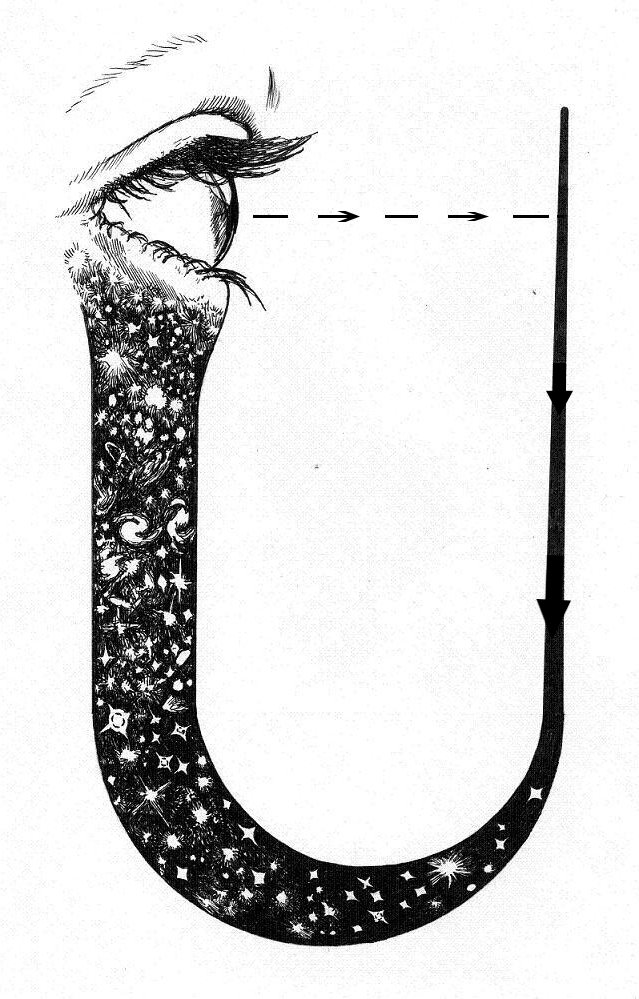
This eye represents the self and the line directly opposite represents that which it is perceiving within the external environment. The two sections are connected into each other via arrows to demonstrate that it is a singular and unified system.
Artist: John Archibald Wheeler
Unity and interconnectedness can be described as experiences where one's sense of self becomes temporarily changed to feel as if it is constituted by a wider array of concepts than it previously did. For example, while a person may usually feel that they are exclusively their “ego” or a combination of their “ego” and physical body, their sense of identity can change during this state to also include the external environment or an object they are interacting with, the external environment, or existence as a whole. This results in intense and inextricable feelings of unity or interconnectedness between oneself and varying arrays of previously "external" systems.
It is worth noting that many people who undergo this experience consistently interpret it as the removal of a deeply embedded illusion, the destruction of which is often described as some sort of profound “awakening” or “enlightenment.” However, it is important to understand that these conclusions and feelings should not necessarily be accepted at face value as inherently true.
Feelings of unity and interconnectedness most commonly occur under the influence of psychedelic and dissociative compounds, such as LSD, DMT, ayahuasca, mescaline, and ketamine. However, they can also occur during well-practiced meditation, deep states of contemplation, and intense focus.
Full article: Ego death
Ego death (also known as ego suppression, ego loss or ego dissolution) is the temporary experience of a partial to complete disruption of a person's sense of self, which often results in a range of profound changes to how the person perceives and interprets their otherwise usually stable sense of identity, agency, and self-hood.
These changes can include but are not limited to any combination of the following three subcategories:
An absent selfhood can be described as a sudden and complete lack of the subjective experience of one's own sense of identity. During this form of ego death, there is a profound experience of remaining fully conscious, while there is no longer an “I” experiencing one's sensory input; there is just the sensory input as it is and by itself, without a conscious agent to comment on or think about what is happening to it.
An objective selfhood can be described as the experience of the person remaining aware of the existence of oneself, while no longer perceiving themselves as integrally attached to their sense of identity. Instead of feeling that they and their sense of selfhood are a unified whole which is the subject of experience, their awareness instead feels entirely separate from it's own sense of self, as if this selfhood is now the object of experience instead of the subject.
An expanded selfhood can be described as the experience of one's sense of identity becoming constituted by a wider array of concepts than it previously did. For example, while a person may usually feel that they are exclusively their “ego” and physical body, this effect can cause their sense of identity to also include the external environment or an object they are interacting with. This results in intense and inextricable feelings of unity or interconnectedness between oneself and varying arrays of previously "external" systems. For more information on this experience, please see our comprehensive article on states of Unity and Interconnectedness
Ego death is well known for the transformative and significant impacts it can often have on a person's perception of both themselves and the world around them. These responses and alterations can occur both during the experience of ego death, but also in the hours, days, or weeks afterwards.
It is most commonly induced under the influence of moderate dosages of hallucinogenic compounds, such as psychedelics, dissociatives, and deliriants.
Full article: Spirituality enhancement
Spirituality enhancement is the experience of a shift in a person’s personal beliefs regarding their existence and place within the universe, their relationship to others, and what they value as meaningful in life. It results in a person rethinking the significance they place on certain key concepts, holding some in higher regard than they did previously, and dismissing others as less important.[1] These concepts and notions are not limited to but generally include:
Although difficult to fully specify due to the subjective aspect of spirituality enhancement, these changes in a person's belief system can often result in profound changes in their personality[5][7][13], which can sometimes be distinctively noticeable to the people around those who undergo it. This shift can occur suddenly, but will usually increase gradually over time as a person repeatedly uses the psychoactive substance inducing it.
Spirituality enhancement is unlikely to be an isolated effect component but rather the result of a combination of an appropriate setting[3] in conjunction with other coinciding effects such as analysis enhancement, novelty enhancement, perception of interdependent opposites, perception of predeterminism, perception of self-design, personal bias suppression, introspection, and unity and interconnectedness. It is most commonly induced under the influence of moderate dosages of psychedelic compounds, such as LSD, psilocybin, and mescaline. However, it can also occur to a lesser extent under the influence of dissociatives, such as ketamine, PCP, and DXM.
Auditory Effects are any subjective effect which directly alters a person's sense of hearing.
Full article: Auditory enhancement
An auditory enhancement is an increase or improvement in the detail and clarity of sound. This can result in the person becoming extremely aware of all the sounds around them with an enhanced ability to comprehend multiple layers of sound and better identify their direction and location.
The most common manifestation of this effect is a greatly enhanced appreciation of music. This can allow people to experience music in a level of detail that is unparalleled during everyday sober living.
Auditory enhancements are often accompanied by other coinciding effects, such as auditory distortion and auditory hallucinations. They are most commonly induced under the influence of moderate dosages of psychedelic compounds, such as LSD, psilocybin, and mescaline. However, they can also occur less commonly under the influence of stimulants, cannabinoids, and dissociatives.
Full article: Auditory distortion
An auditory distortion is the experience of perceived alterations in how audible noises present and structure themselves.
These distortions can manifest in many styles, but commonly take the form of echoes or murmurs that arise from sounds and are accompanied by fluctuating changes in speed and pitch. This can intensify to the point where sounds are consistently followed by continuous reverberation, often rendering the original sound completely unrecognizable. However, it often quickly resets to base level and starts over if the source of noise is stopped or changed.
At lower levels, auditory distortions consist of subtle and spontaneous reverberations, echoes, and changes in the pitch of noises within the external environment. They are fleeting, low in intensity, and easy to ignore. However, at higher levels, auditory distortions become consistent and intense enough that they are impossible to ignore. The complexity of these resulting alterations can quickly render the original sound as unintelligible.
Auditory distortions are often accompanied by other coinciding effects, such as auditory hallucinations, auditory suppression, and auditory enhancement. They are most commonly induced under the influence of moderate dosages of psychedelic compounds, such as LSD, 5-MeO-DiPT, and DMT. However, they can also occur less commonly under the influence of dissociatives, such as ketamine, PCP, and nitrous.
🎵 Audio replication: Distorted math lecture by /u/Hyperactive_Filly
Full article: Auditory hallucination
An auditory hallucination is the experience of hearing spontaneous and imaginary noises. The most common examples of this include hearing clips of sound such as imagined music, voices, tones, popping, and scraping, but can also be an infinite variety of other potential noises that are stored within one's memory.
In terms of their behavior, these sounds will often be based on noises that were expected to occur or have been genuinely heard on a frequent basis within the external environment. For example, a person may repeatedly hear a knock at the door when they are expecting a visitor or hear music they were listening to earlier on in the day. However, at other times, auditory hallucinations may also present themselves as completely new or unusual sounds unlike anything that could currently occur within the external environment.
Auditory hallucinations are often accompanied by other coinciding effects, such as auditory distortion and auditory enhancement. They are most commonly induced under the influence of moderate dosages of hallucinogenic compounds, such as psychedelics, deliriants, and dissociatives.
🎵 Audio replication: Audio content
Tactile Effects are any subjective effect which directly alters a person's sense of touch.
Full article: Tactile enhancement
Tactile enhancement is an overall increase in both the intensity of a person's sense of touch and their awareness of the physical sensations across their body. At its highest level, this becomes extreme enough that the exact location and current sensation of every single nerve ending across one's skin can be felt all at once. In contrast, most people can only maintain awareness of the tactile sensations that are relevant to their current situation in their sober state.
This effect can result in tactile sensations such as touching, hugging, kissing, and sex becoming greatly enhanced in terms of the pleasure they induce. However, it can also result in an over-sensitivity of the skin, which causes the same sensations to become uncomfortable and overwhelming.
Tactile enhancement is often accompanied by other coinciding effects, such as spontaneous bodily sensations and physical euphoria. It is most commonly induced under the influence of moderate dosages of psychedelic compounds, such as LSD, psilocybin, and mescaline. However, it can also occur under the influence of stimulants, cannabinoids, and certain dissociatives
Full article: Spontaneous tactile sensations
Spontaneous tactile sensations are the experience of sensations across the body occurring without any obvious or immediate physical trigger. This results in feelings of seemingly random yet distinct tingling sensations that occur across the skin and within the body. The styles of sensations felt vary greatly depending on the psychoactive substance consumed.
At lower levels, the sensation of this effect can be described as subtle and fleeting tingling sensations throughout the body. These sensations do not impair physical motor control and can essentially be ignored if one wishes to do so. However, at higher levels, the tingling sensations increase enough to become a powerful, uncontrollable focus point of the person’s attention. This can feel completely overwhelming and heavily impairs a person’s motor control, leaving them either lying or sitting down, incapable of standing up due to the all-encompassing sensations.
Spontaneous tactile sensations are often accompanied by other coinciding effects, such as tactile enhancement and physical euphoria. They are most commonly induced under the influence of moderate dosages of psychedelic compounds, such as LSD, psilocybin, and mescaline. However, they can also occur under the influence of stimulants, cannabinoids, and dissociatives.
Multisensory Effects are any subjective effect which directly alters two or more senses simultaneously. Although some hallucinatory effects may affect multiple senses at one time they are usually not categorized as 'multisensory effects' unless they do so consistently.
Full article: Scenarios and plots
Scenarios and plots are the situations, stories, and events that occur within both external and internal hallucinations. These behave in an almost identical fashion to the plots and scenarios that occur during ordinary dream states and often include cognitive delusions that result in one accepting the plot as a real-life event. On rare occasions, however, they will be immediately recognized as a mere hallucination and not a real-life event.
During this effect, the typical components that comprise standard hallucinatory states (settings, sceneries, and landscapes and autonomous entities) begin behaving and co-operating in a manner that results in the experience of events occurring within the hallucination itself. These are often perceived as linear and coherent plots that occur in a logical sequence by leading into other events through normal cause and effect. However, they are equally likely to present themselves as completely nonsensical and incoherent. For example, they may consist of nonlinear or spontaneous events that are capable of ending, starting, and changing between each other repeatedly in quick succession.
Scenarios and plots are most commonly induced under the influence of heavy dosages of hallucinogenic compounds, such as psychedelics, dissociatives, and deliriants. However, they can also occur less commonly under the influence of stimulant psychosis and sleep deprivation.
Full article: Memory replays
Memory replays are a multisensory subtype of internal hallucinations that result in a person reliving memories through the experience of vivid daydreams, reoccurring emotions or sensations, and hallucinations. At higher levels of intensity, these are often referred to as "flashbacks". The memories themselves can be significant life events with high levels of personal meaning attributed to them, generic recent occurrences, or long forgotten experiences from childhood.
Memory replays are often accompanied by other coinciding effects, such as scenarios and plots, internal hallucinations, and introspection. They are most commonly induced under the influence of heavy dosages of hallucinogenic compounds, such as psychedelics, dissociatives, and deliriants. However, they can also commonly occur during sobriety as a result of traumatic experiences, particularly when the person suffers from post-traumatic stress disorder.
Full article: Synaesthesia
Synaesthesia (also spelled synesthesia or synæsthesia) is the experience of a blending, merging, or mixing of the senses. For example, a person experiencing synaesthesia may begin seeing music, tasting colors, hearing smells, or any other potential combination of the senses. At its highest level, synaesthesia becomes so all-encompassing that each of the senses become completely intertwined with the rest of one's senses. This is a complete blending of human perception and is usually interpreted as extremely profound when experienced. It is worth noting that a significant percentage of the population experience synaesthesia to varying extents during everyday life without the use of drugs.
Synaesthesia is commonly induced under the influence of heavy dosages of psychedelic compounds, such as LSD, psilocybin, and mescaline. However, it is seemingly most commonly experienced under the influence of stimulating psychedelics such as the 2C-x, DOx, and Nbome series.
Physical Effects are any subjective effect which directly affects an aspect of a person's physical body. Although many uncomfortable physical effects also technically fit into this definition, they are excluded from this category as they have their own defining qualities.
Full article: Pupil dilation
Artist: Unknown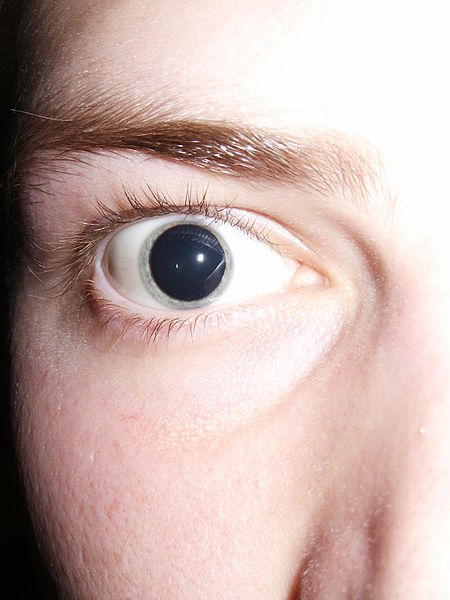
Pupil dilation is most commonly induced under the influence of moderate dosages of a wide variety of serotonergic compounds, such as psychedelics, dissociatives, deliriants, entactogens, various stimulants and some antidepressants.
Full article: Bodily control enhancement
Bodily control enhancement can be described as feeling as if there has been a distinct increase in a person's ability to control their physical body with precision, balance, coordination, and dexterity. This results in the feeling that they can accurately control a much greater variety of muscles across their body with the tiniest of subtle mental triggers.
The experience of this effect is often subjectively interpreted by people as a profound and primal feeling of being put back in touch with the animal body.
Bodily control enhancement is most commonly induced under the influence of moderate dosages of stimulating psychedelics, such as LSD, 2C-B, and DOC. However, it may also occur to a lesser extent under the influence of other compounds such as traditional stimulants and light dosages of stimulating dissociatives.
Full article: Laughter fits
Laughter fits can be described as the experience of uncontrollable, intense, and spontaneous laughter which continue to occur despite a lack of any identifiable trigger or a feeling of humorousness. The physical action itself typically consists of rhythmical, often audible contractions of the diaphragm and other parts of the respiratory system. At higher levels, laughter fits can make it extremely difficult to function due to crying and a difficulty talking or keeping one's eyes open.
Laughter fits are often accompanied by other coinciding effects such as an increased sense of humour and emotion enhancement. They are most commonly induced under the influence of moderate dosages of psychedelic and dissociative compounds, such as LSD, psilocybin, and nitrous oxide.
Uncomfortable Effects An uncomfortable physical effect is any substance-induced alteration of a person's physical state which is unpleasant, undesirable, painful, or otherwise a source of distress. In most cases they indicate a temporary part of a substance's interaction with the body. However, in certain contexts, they can also indicate the need for attention or even medical treatment if they become dangerously severe.
Full article: Nausea
Nausea can be described as a sensation of unease and discomfort in the upper stomach combined with an involuntary urge to vomit. It often, but not always, precedes vomiting. This effect usually occurs at the onset of the experience and dissipates as the peak takes its toll.
In the context of substance usage, nausea and vomiting can occur as a result of stomach irritation through the consumption of materials which it is not used to digesting. These materials can include things such as chemical powders or plant matter. Alternatively, nausea may occur as a direct pharmacological result of how the particular substance affects the brain. If this is the case, the nausea is therefore inseparable from the experience itself and will likely occur to varying extents regardless of the route of administration.
Nausea is often accompanied by other coinciding effects such as stomach bloating, stomach cramps, and dizziness. It is most commonly induced under the influence of heavy dosages of a wide variety of compounds, such as psychedelics, opioids, GABAergics, deliriants, dissociatives, and stimulants.